Posts

Kavakos, Ma, and Ax find power and subtlety in all-Beethoven Tanglewood recital

Image
  Photo: Hilary Scott Looking to establish himself as an original voice, Beethoven poured his first significant effort into piano trios, a genre he felt his predecessors Mozart and Haydn had not taken seriously. Of his Op. 1 set, the Piano Trio No. 3, cast in C minor, shows evidence of the Beethoven to come. Sudden shifts in dynamics and key create brooding tension, as if the composer was testing the very limits of high 18th-century style. (Haydn had criticized the score as unsuitable for contemporary Viennese audiences.)   Yet violinist Leonidas Kavakos, cellist Yo-Yo Ma, and pianist Emanuel Ax explored all the work’s classical-era elegance when they rendered the trio at Tanglewood's Koussevitzky Shed Friday night. By turns graceful and dramatically understated, the performance revealed early Beethoven less as a transitional figure and more of a composer firmly rooted in the style he had absorbed in his youth.   From the opening bars of the Allegro con brio, ...
The Ultramodernist Trajectory of Bob Graettinger

Image
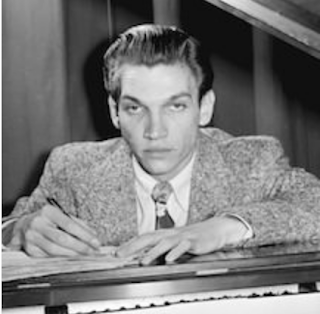
Robert "Bob" Graettinger (1923-1957) While playing with Stan Kenton’s orchestra at the Hollywood Palladium one night in 1941, bassist Howard Rumsey spotted a tall, gaunt teenager hanging around the bandstand. At intermission, the kid introduced himself. He was Bob Graettinger, and he had some arrangements with him. He asked Rumsey if Kenton would have a look at them. Kenton, who eagerly sought new talent, felt they were ambitious but amateurish. He told Graettinger to keep trying. Six years later, having cut his professional teeth as saxophonist and arranger with bands led by Ken Baker, Benny Carter, and Bobby Sherwood, Graettinger approached Kenton again. His new arrangement, “Thermopylae,” presented to Kenton during a rehearsal in Hollywood, would eventually redefine big band modernism.   Kenton led the band in a reading of the work. Impressed, he hired Graettinger as an arranger. All of the music the young man eventually penned for Kenton encapsulated a sound the bandleade...

Kenton pro Wagner

Image
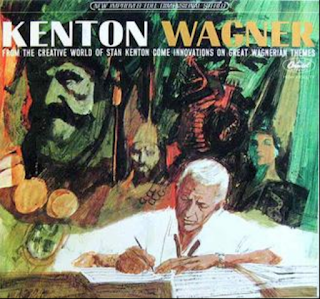
 Stan Kenton released an album of Wagner themes in 1964 “I don’t think jazz was meant to continue as dance music,” Stan Kenton told Nat Hentoff, jazz critic for DownBeat magazine, in 1952. “What jazz is going to evolve into is an American style of—if I can use the word—classical music. And that’s what we’re trying to do.”   That mission defined Kenton’s long career and resulted in recordings that brought symphonic jazz into regions few expected or even wanted. The Progressive Jazz of Kenton’s band in the late 1940s looked to the music of Stravinsky and Bartók as models, a trend that continued with the Innovations Orchestra in the early 1950s and resulted in the thoroughly dissonant—and fan-alienating—album, City of Glass . Kenton and arranger-composers such as Pete Rugolo and Bob Graettinger were convinced that the only way to make jazz survive was to fuse it with the jagged sonorities of modern classical music.   So it was perhaps a surprise to Kenton fans that the band...

Jeremy Denk explores Romantic-era love triangle in Celebrity Series virtual recital

Image
Robert and Clara Schumann. Source: Wikimedia Commons Robert Schumann, Clara Schumann, and Johannes Brahms were no strangers to personal tragedy. Clara had lost her husband Robert to depression, a suicide attempt, and eventually death in an asylum. Brahms, who loved and longed for Clara, stepped in to comfort her. But plans for the couple to marry in 1856 were thwarted for reasons that have been lost to history. Each composer continued to hold a candle for the other and crafted music of both exuberance and melancholy, perhaps reflecting the joys of memory and pain of loss. That was the sense pianist Jeremy Denk conveyed in his Celebrity Series recital, streamed live from WGBH Fraser Studio on Sunday night.  Denk remains a thinker’s pianist, and the program explored the Schumann-Brahms love triangle through early and late works by the three composers. Missy Mazzoli’s Bolts of Loving Thunder, also heard Sunday night, refashioned Brahmsian gestures in a bold, twenty-first-century styl...

"The Soul of the Orchestra": Newton's New Philharmonia

Image
The New Philharmonia By their very nature, community orchestras are welcoming places where musicians of all levels can come together to play a wide range of repertoire. But the New Philharmonia has maintained a tradition of presenting concerts that consistently meet professional standards. Celebrating its twenty-fifth anniversary this season, the Newton-based orchestra balances high caliber performances with community engagement by continuing to build upon its founding principle—it is, first and foremost, a musicians’ ensemble. “It was the musicians who started the orchestra, and it is the musicians who are actually the soul, the core, of the orchestra,” said conductor Francisco Noya in a recent phone conversation from Argentina. “It’s a very special thing.” Those musicians—many of whom hold degrees in music from prestigious institutions—strive to make every performance gleam with polish and precision. Such a vision stemmed from the orchestra’s first director, Ronald K...